Apple Valley's Trusted Real Estate Guide

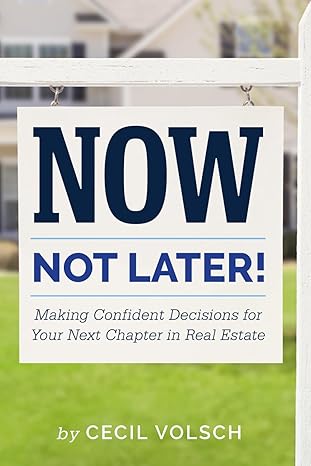
Now, Not Later!

Making Confident Decisions for Your Next Chapter in Real Estate

Whether you're a homeowner sitting on equity or a renter ready to break free — this book reveals the traps that cost buyers their future, and the decisions that change everything.

Buy on Amazon
25+ Years in Real Estate
2 Books in One
CA DRE #01405643
Now, Not Later! by Cecil Volsch — Book Cover

CA DRE #01405643

About the Author

Cecil Volsch

Cecil Volsch is a seasoned real estate professional serving the Apple Valley, California area and the greater High Desert region. With over two decades of experience guiding buyers, sellers, and renters through pivotal real estate decisions, Cecil has developed a reputation for clarity, patience, and uncommon care.

Born from years of front-row experience watching real estate decisions either transform or cost families their futures, Now, Not Later! is Cecil's most direct gift to the clients he serves — distilled wisdom in a form anyone can act on, today.

Cecil leads The Volsch Team, dedicated to helping clients navigate the decisions that shape their financial lives and the chapters ahead.

California DRE #01405643
Credentials & Expertise

Licensed Agent

California DRE #01405643 — fully licensed and experienced in residential real estate.

Apple Valley Expert

Deep local knowledge of the High Desert market, from pricing trends to community fit.

Published Author

Author of Now, Not Later! — a dual-guide for homeowners and renters alike.

The Volsch Team

Founder of The Volsch Team at VolschTeam.com.

The Book

Two Guides. One Essential Truth.

Real estate decisions don't wait for perfect conditions — and neither should you. Now, Not Later! delivers hard-won clarity for two distinct audiences, each with everything to gain.

I

Beyond the Numbers

A Guide to Life-Centered Real Estate Decisions

Written for homeowners who have built equity and are considering their next move. This book reveals why waiting for perfect rates is the most expensive mistake you'll never see coming.

Discover how your equity changes every financial calculation, why the true cost of space goes far beyond your mortgage, and how to make decisions by your life clock — not the market clock.

Existing Homeowners Equity Strategy Life Planning
II

Breaking Free

A Renter's Guide to Homeownership

Written for renters who are ready to stop building someone else's wealth. Every month you rent is a month of equity you'll never recover — and this book shows you exactly how to escape that cycle.

From the rent trap and inflation squeeze to overcoming the perfect-timing myth, this guide gives renters an honest, actionable roadmap to their first home.

First-Time Buyers Renters Action Plan

The goal isn't perfect timing — it's purposeful timing that aligns your housing situation with your life priorities while you still have the capability and energy to create the changes you want. — Cecil Volsch, Now, Not Later!

Inside the Book

Chapter by Chapter

Click any chapter to read a detailed summary.

Your home should serve your life, not consume it. Yet many homeowners find themselves managing properties that no longer match how they actually live — heating rooms they rarely enter, maintaining spaces that once buzzed with family life but now sit silent.

The Financial Reality of Excess Space

The financial burden extends far beyond the mortgage payment. Larger homes demand proportionally higher costs across every ownership category. Every additional 1,000 square feet can add $4,000 to $8,000 annually in utility costs alone. Property taxes, insurance, cleaning, and maintenance all scale with size. Over a ten-year period, the cost differential between maintaining 3,500 versus 2,000 square feet of similar quality can easily reach $50,000 to $120,000.

The Hidden Drain on Time and Energy

Beyond finances lies cognitive load — the mental effort required to manage systems, coordinate maintenance, and oversee upkeep. Large homes fragment your attention across property management tasks, consuming hours each week that could be invested in relationships, health, and experiences. The physical demands grow more apparent with age.

Making Informed Space Decisions

Honest usage assessment is the foundation: track which rooms you actually occupy over a typical month. Note which maintenance tasks consistently drain your energy. Calculate the true financial cost of space you don't actively use. The goal isn't to judge past choices — it's alignment between your current reality and your living environment.

When homeowners tell Cecil they're waiting for rates to drop from six percent back to three, he understands the impulse. But this focus on interest rates often obscures a fundamental truth: for established homeowners with substantial equity, the traditional affordability equation has changed entirely.

The Equity Advantage

Consider a homeowner with $350,000 in equity purchasing a $400,000 property. They borrow only $50,000 — creating a monthly payment around $300 at six percent. Compare this to a first-time buyer financing $320,000 at the same rate: $1,918 monthly. Rate obsession becomes misleading when equity insulates you from rate sensitivity.

The Hidden Costs of Waiting

Every year of waiting for better market conditions comes with carrying costs: property taxes of $10,000–$15,000, insurance of $2,000–$3,000, maintenance averaging 1–2% of home value, and utilities. Two years of waiting alone could cost $30,000–$40,000. For rates to justify this delay, the drop would need to save you more than you're spending to stand still.

Redefining Value Beyond Numbers

The most successful homeowners Cecil works with practice financial pragmatism — respecting sound money management while recognizing that personal fulfillment and family connection have value that doesn't appear on spreadsheets. The mathematics of what matters includes the compound interest of family relationships, the appreciation of personal freedom, and the depreciation of unused time.

Where you live shapes who you see, what you do, and how engaged you remain with the world. Distance that feels manageable in your sixties can become prohibitive in your seventies, transforming geography into barriers between you and the people who give your life meaning.

Family Connections and Life's Timeline

Grandchildren don't pause their development waiting for ideal visiting conditions. The grandparent who lives an hour away might attend major events but misses the casual moments that often prove most precious — the impromptu dinner invitation, the after-school pickup, the sick day when extra help is needed. The years spent living at a distance from your priorities are years of connection you cannot recover.

Healthcare and Community Access

Healthcare proximity becomes increasingly critical as medical needs evolve. The specialists you trust, the hospital where your doctors practice, the physical therapy clinic that knows your history — these become more valuable with age. Emergency situations become more complicated when trusted care is distant.

Strategic Proximity Planning

The goal isn't minimizing distance — it's creating sustainable patterns of engagement. Position yourself within a reasonable radius of your most important relationships and activities. Plan for future transportation realities. Moving closer to your priority network while you still have the energy and capability to build new community ties proves far more successful than waiting until proximity becomes a necessity.

There are two clocks governing your housing decisions: the market clock and your life clock. While watching market conditions is reasonable, your energy, health, and relationships operate on a different timeline — one that doesn't pause for perfect conditions.

The Mathematics of Market Timing

If you're spending $25,000 annually in carrying costs on your current home while waiting for a 1% rate improvement, that waiting period needs to save you more than the costs you're accumulating. For someone borrowing only $100,000 on their next home (thanks to substantial equity), a 1% rate difference equals roughly $50–$80 per month in payment savings. At that rate, it would take over twelve years to recover just one year's carrying costs.

The Price of Waiting

Every season spent in the wrong home is a season you cannot experience in the right one. The grandparent who waits three years for better market conditions to move closer to family misses three years of school events, three holiday seasons, three summers of playground visits. No amount of interest rate savings can purchase those experiences after they've passed.

Personal Readiness Over Market Perfection

Your life clock is more reliable than any market forecast because it's based on realities you can observe and control. When your current home no longer supports the life you want, when distance keeps you from people you love, when maintenance demands exceed your interest in managing them — these signals matter more than any economic indicator.

At its heart, a home is the stage where your life unfolds. The decision to stay or move ultimately comes down to this: where do you want to write your next chapter?

Deploying Your Equity Strategically

The equity you've built over decades represents more than numbers on financial statements — it's stored potential, accumulated freedom that can be deployed strategically to support your vision for your remaining years. This resource can purchase proximity to grandchildren, freedom from maintenance responsibilities, or financial flexibility for experiences you've deferred during busier life stages.

The Importance of Proactive Timing

Making changes while you have full energy and choice typically produces better outcomes than waiting until circumstances force hasty decisions. The proactive move allows time to research communities thoroughly, build new relationships gradually, and establish routines while you still have the capability to manage complex transitions.

Embracing Change as Growth

Success in chapter transitions often depends on viewing change as addition rather than subtraction. Instead of focusing on what you're leaving behind, emphasize what you're gaining — more time with family, reduced maintenance, new community connections. The most fulfilling next chapters often surprise their authors. Your next chapter is waiting to be written — but it won't write itself.

When you rent, every dollar you pay belongs to someone else. Month after month, you are building equity — for your landlord, not for yourself. Your rent covers their mortgage principal, pays down their loan balance, and increases their net worth. Meanwhile, you receive thirty days of housing, and then the cycle starts over.

The Hidden Transfer of Wealth

This wealth transfer is invisible but relentless. A teacher who spent seven years renting at $1,400/month paid $117,600 in rent. The homeowner used her payments to reduce their mortgage by approximately $40,000 while the property appreciated by another $65,000. Seven years of payments helped create $105,000 in wealth for someone else. When she finally came to buy, she was starting from zero.

The Rent Never Stops Rising

Unlike mortgage payments, rent never stays fixed. Annual increases of 3–5% mean that by year eight, a $1,100 apartment becomes $1,500+. Over eight years: $118,000+ in rent paid. Had that person purchased a $170,000 home with a $1,200 monthly payment in year one, they would have owned approximately $50,000 in equity — and their payment would have remained fixed.

Breaking Free from the Cycle

The rent trap masquerades as financial caution — it convinces you that you're being responsible while quietly preventing you from building wealth. Two friends, each earning $50,000/year: one rented for ten years ($1,300/month), the other bought ($1,350 mortgage). After ten years: the renter paid $156,000 and owns nothing; the homeowner paid $162,000 and owns approximately $85,000 in equity. That extra $50/month built $85,000 in wealth.
The belief that perfect market conditions will align to create the ideal buying opportunity is one of the most seductive and expensive myths in real estate. Real estate markets are influenced by dozens of variables that never align perfectly.

The Moving Goalpost Problem

The perfect timing myth creates a moving goalpost. Each time market conditions improve in one area, renters shift their focus to another factor that isn't ideal. When interest rates drop, they worry about high prices. When prices soften, they fear rates might rise. One client watched this pattern over four years: year one — rates too high; year two — prices too expensive; year three — not enough saved; year four — worried about recession. Meanwhile, his rent increased from $1,200 to $1,500/month, and the homes he watched rose in price by $40,000.

The Opportunity Cost

Two scenarios: Bought immediately — home price $250,000, monthly payment $1,400. After 3 years: $18,000 in principal paid, $25,000 in appreciation. Total wealth created: $43,000. Waited 3 years then bought — rent paid during wait: $45,000. Home price after 3 years: $285,000. Monthly payment: $1,580. Wealth created during wait: $0. Her three-year wait for perfect timing cost her $43,000 in lost wealth creation plus $180 more per month going forward.

The Real Perfect Timing

The right time to buy isn't determined by market conditions — it's determined by personal readiness. You should buy when your income can support the payment comfortably, when you have funds for a down payment and closing costs, when you're ready to stay in the area for several years. None of these factors depend on interest rates or market predictions. They depend on your life circumstances.

Inflation attacks renters from multiple directions: home prices rise, rents increase, construction costs climb, and the purchasing power of their savings erodes. Every month spent accumulating "just a little more" often results in needing significantly more.

The Futile Race to Save

One client who was concerned about rising home prices decided to rent for one more year while saving aggressively. He cut expenses, took a side job, and managed to save an additional $12,000. But during that year, the homes he wanted increased by $65,000 in price. His extraordinary savings effort left him $33,000 further behind. The mathematical reality: if home prices inflate at 6% annually and you save an extra $1,000/month, you need to be shopping for homes under $200,000 just to break even.

How Homeownership Beats Inflation

Fixed-rate mortgages are powerful inflation tools — they lock in your largest expense at today's dollars while the asset typically appreciates with inflation. Cecil helped a client buy a home with an $1,800 monthly payment representing 28% of her income. Five years later, through normal salary increases, that same payment represented only 22% of her income. Her neighbor's rent increased from $1,400 to $2,150 over the same period.

Breaking the Inflation Cycle

The only way to escape the inflation squeeze is to stop being squeezed by it — transitioning from variable housing costs (rent) to fixed housing costs (a mortgage) as quickly as possible. Focus on payment affordability rather than perfect down payment amounts. If you can afford the monthly payment now, buy now.

Extended renting creates hidden costs that no financial calculator captures: the limitation of life experiences, the postponement of dreams, and the psychological weight of temporary living that stretches into years.

The Temporary Mindset Trap

Renting creates a temporary mindset affecting every aspect of daily life. Clients live in spaces they can't truly make their own, in neighborhoods they don't feel fully connected to, with an underlying sense that their current situation isn't permanent. One client spent five years in a rental house postponing everything — the garden he wanted, the home office that would advance his career, the dog he'd always wanted. "I keep telling myself I'll do these things when I buy," he admitted. "But years keep passing."

The Creative Limitation

Rental agreements typically restrict modifications, improvements, and personalization. An artist who came to Cecil after six years in a rental with poor lighting couldn't install proper studio lighting, couldn't modify her workspace. When she finally bought and created a proper studio, her artistic output and income increased dramatically. "I didn't realize how much the space was holding me back."

The Psychological Weight of Impermanence

Psychology research consistently shows that stable housing contributes to better mental health outcomes, stronger social relationships, and improved life satisfaction. A longtime client described life after buying: "I didn't realize how much mental energy I was spending on housing uncertainty until it was gone. Always wondering if my rent would increase, if my landlord would sell, if I'd have to move again. When I finally owned, it was like a weight I didn't know I was carrying just disappeared."

The transition to homeownership begins in your mind, not your bank account. Successful renters who make the leap share certain mental shifts that transform how they approach housing decisions.

Stage 1: Shifting Your Mindset

From perfect conditions to good enough conditions. From renting mentality to equity-building focus. From flexibility fears to stability benefits. "I realized I was waiting for permission from the market instead of taking responsibility for my own decision," one client said. The first mindset shift: instead of asking "Are conditions ideal?" ask "Are conditions workable?"

Stage 2: The Readiness Assessment

Financial readiness isn't just about a down payment — it's about sustainable homeownership. Check income stability (two years consistent), debt-to-income ratio (below 43%), down payment resources (3–20%), emergency fund (3–6 months of expenses), and credit score (above 640). Geographic stability (plan to stay 3+ years) and relationship stability matter equally.

Stage 3: Overcoming Common Fears

Fear of making a mistake, fear of market timing, fear of responsibility — these are universal and understandable. But the biggest risk in real estate isn't buying at the "wrong" time. It's not buying at all. Markets fluctuate, but long-term trends favor ownership. The fear of mistakes often costs more than actual mistakes.

Stage 4: Your Action Timeline

Months 1–2: Get pre-approved, assemble your team, define your criteria, research neighborhoods. Months 2–4: Begin home tours, refine criteria, monitor market activity, prepare documentation for quick offers. Months 4–6: Write competitive offers, navigate negotiations, manage the closing process. Year 1: Track all expenses, build maintenance reserves, understand tax benefits, consider refinancing opportunities.

By the Numbers

What the Data Shows

Real numbers from real clients — the financial case for moving now rather than waiting.

$50,000+ Typical 10-year rent vs. own wealth gap for first-time buyers at similar payment levels
$40–120K 10-year cost differential between maintaining large vs. right-sized space
6%+ Typical annual home price appreciation that outpaces most renters' savings rate
Year 1 When most homeowners begin to feel the clarity, stability, and equity advantage of owning
Questions & Answers

Frequently Asked

Who is this book written for?

The book is written in two parts. Book One is for homeowners with equity who are considering their next move. Book Two is for renters who are ready to break free from the rental cycle and begin building wealth through homeownership.

What is the core message of "Now, Not Later!"?

That waiting for perfect market conditions is one of the most expensive decisions you'll never see coming. Whether you're a homeowner or a renter, the best time to make a confident real estate move is when your life circumstances call for it — not when market stars align.

Does Cecil work with first-time buyers?

Absolutely. Cecil has guided countless renters through the transition to homeownership, helping them escape the rent trap and begin building real, lasting wealth through equity.

I'm a homeowner with equity — is the book still relevant for me?

Yes. Book One is written specifically for established homeowners. It challenges the rate obsession trap, explores the true cost of space, and makes a powerful case for why life timing matters more than market timing.

Where can I purchase the book?

Now, Not Later! is available on Amazon. Click the "Buy on Amazon" button anywhere on this page, or visit a.co/d/0dMNsjjG.

What is Cecil's license number?

Cecil Volsch is a licensed California real estate agent. California DRE License #01405643.

Ready to Take the First Step?

Whether you're ready to explore your equity, escape the rent cycle, or simply have questions about what's possible — Cecil is here to guide you with uncommon clarity and care.

✉️
📋 CA DRE #01405643
Ready to Begin?

Let's Start Your Journey

CA DRE #01405643